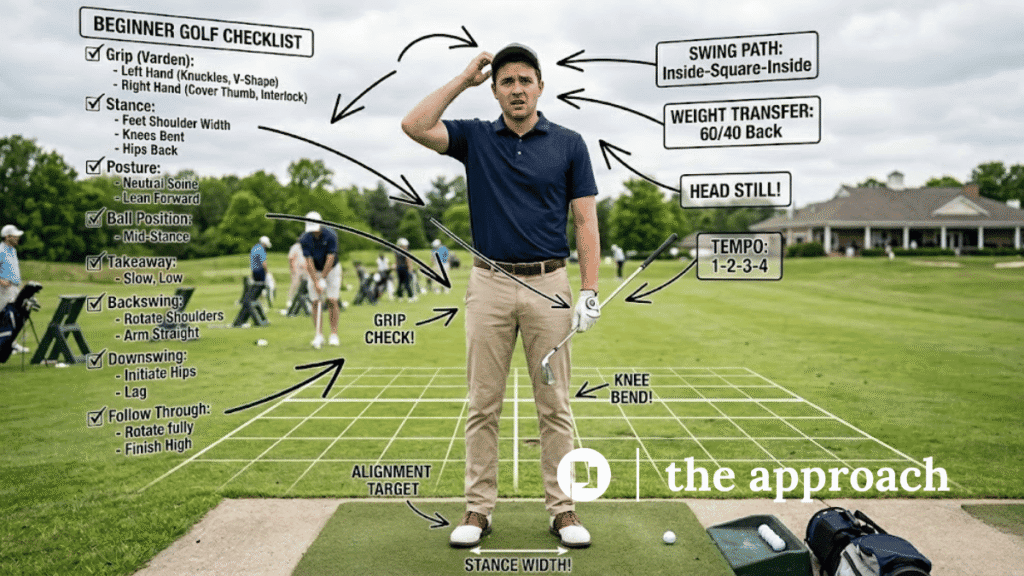
You’re standing on the range. First lesson.
Your instructor has just told you to:
- Keep your left arm straight
- Rotate your hips 45 degrees
- Shift your weight forward
- Tuck your right elbow
- Keep your head still
- Don’t break your wrists too early
You step up to the ball. You try to remember everything.
You swing. You miss the ball completely.
Welcome to golf.
If you’re a beginner looking for “golf swing basics,” you’ve likely run into a wall of information.
YouTube videos. Magazine tips. Well-meaning friends. Everyone has advice.
And all of it makes golf harder than it needs to be.
By the time you actually stand over the ball, your brain is so crowded with positions that your body forgets how to move.
Let me show you why this happens—and more importantly, how to learn golf the way you learned every other athletic skill in your life.
Why Golf Instruction Fails Beginners
Here’s what most beginners don’t realize:
Traditional golf instruction isn’t designed to help you learn. It’s designed to be easy to teach.
Think about it:
Body positions are visible on video. You can see them. Point to them. Measure them.
Motion is a feel. It’s harder to see. Harder to explain. Harder to grade.
So instructors default to what’s easy to teach: positions.
“Get your club here at the top.”
“Your hips should be rotated this much.”
“Your wrist angle should look like this.”
But here’s the problem:
Teaching what’s easy to SEE isn’t the same as teaching what actually WORKS.
Golf is not a series of positions. Golf is a motion.
And you can’t learn motion by memorizing positions any more than you can learn to throw a ball by studying elbow angles.
The Fundamental Mistake
The greatest error in beginner golf instruction is this:
Teaching the body before teaching the tool.
Think about any other tool you use:
- When you hammer a nail, you don’t think about your shoulder angle. You focus on the head of the hammer.
- When you sweep the floor, you don’t monitor your hip rotation. You focus on the broom moving across the floor.
- When you write your name, you don’t consciously manage finger pressure. You focus on forming the letters.
You focus on the tool and what it needs to do. Your body figures out how to support that action.
Golf should be no different.
As the legendary teacher Ernest Jones taught in the 1920s:
“The golf swing is a singular motion of the club head.”
Not a series of body positions. A motion of the club head.
What This Means for You as a Beginner
Download the FREE 5-Day Clubhead Awareness Tune-Up and learn the simple approach that makes golf easier, not harder.
If you’re just starting golf, you have a huge advantage:
You haven’t been corrupted by mechanical thinking yet.
You haven’t spent years trying to force positions. You haven’t built bad habits from position-based instruction.
You can learn golf the right way from day one.
And the right way is simple:
Forget the positions. Feel the weight of the club head.
That’s it. That’s the entire foundation.
Not:
- ❌ Where should my left arm be?
- ❌ How much should my hips rotate?
- ❌ What’s my shoulder plane?
Just:
- ✅ Can I feel the weight of the club head?
- ✅ Can I swing that weight smoothly?
- ✅ Can I maintain rhythm and balance?
Everything else takes care of itself.
How Your Body Self-Organizes
Here’s what happens when you focus on the club head instead of your body:
Your brain is brilliant at solving movement problems when you give it a clear external task.
Tell it: “Swing the club head to the target.”
And it figures out:
- How much to turn your shoulders
- When to shift your weight
- How to sequence everything
- Where to position your arms
You don’t have to micromanage any of it.
Your body knows how to swing. You’ve been swinging things since you were a toddler—sticks, bats, rackets.
The problem is when you try to override that natural coordination with conscious control.
Tell your brain: “Rotate your hips 45 degrees while maintaining lag and keeping spine angle constant.”
And you override its natural problem-solving ability. You create mechanical, robotic motion.
That’s why beginners struggle. Too many instructions. Not enough motion.

The Handkerchief Drill: Feel What Swinging Actually Means
Ernest Jones used this drill with thousands of students over decades. It works because it’s impossible to fake.
You can’t muscle it. You can’t force positions. You just have to swing.
What You Need:
- A handkerchief or small towel
- A pocket knife, or a few quarters/coins
- Something to tie them together (rubber band works)
Setup:
- Tie the pocket knife (or coins) into the corner of the handkerchief
- Hold the opposite corner in your hand
- Let the weighted end hang down
The Exercise:
Try to swing that weight in a smooth circle—like you’re stirring a big pot.
Notice a few things:
1. You can’t “push” the handkerchief
You have to pull it. The weight wants to swing. Your job is just to guide it.
2. If you jerk your body, the handkerchief collapses
The motion has to be smooth and continuous. Any sudden movement breaks the rhythm.
3. The only way to keep the circle moving is with a consistent rhythm
Not force. Not positions. Rhythm.
That’s your golf swing.
Your club is simply a heavier version of that handkerchief.
The club head has weight. Your job is to swing that weight smoothly.
When you feel this—really feel the weight wanting to swing—you understand golf.
What Changes When You Think This Way
Let me show you the difference:
Position-Based Learning (Traditional Method):
What you’re thinking:
- “Left arm straight”
- “Hips at 45 degrees”
- “Head still”
- “Weight forward”
- “Elbow tucked”
What happens:
- Stiff, mechanical motion
- Lots of thinking, no flow
- Inconsistent contact
- Tension everywhere
- Frustration
Result: You spend months or years trying to force your body into positions, never developing natural rhythm or feel.
Motion-Based Learning (The Approach):
What you’re thinking:
- “Feel the club head”
- “Swing it smoothly”
- “Maintain rhythm”
What happens:
- Athletic, flowing motion
- Natural rhythm
- Better contact almost immediately
- Body relaxes and supports the motion
- Fun
Result: You develop a natural, repeatable swing based on feel and rhythm—the way every good golfer actually plays.
See the difference?
One approach creates robots. The other creates athletes.
Your First Three Steps
If you’re brand new to golf, or if you’ve been struggling with mechanical instruction, here’s where to start:
Step 1: Hold the Club Lightly
The mistake: Most beginners grip the club like they’re trying to strangle it.
Tension kills feel. If your forearms are tense, you can’t sense the weight of the club head.
The solution: Hold the club like you’re holding a pen while writing your signature.
Tight enough to secure but loose enough to flow.
How to check: Your forearms should be relaxed. The club should feel like it could slip (but won’t).
Step 2: Sense the Club Head

The mistake: Most beginners never connect with the tool they’re swinging.
They address the ball and immediately start thinking about body positions.
The solution: Before every swing, waggle the club.
Feel where that heavy metal piece is in space. Notice the weight at the end of the shaft.
What you’re looking for: A clear sensation of where the club head is—not just intellectually knowing it’s there, but actually feeling it.
Step 3: Swing the Tool, Not the Body
The mistake: Trying to create motion by moving body parts.
“Rotate my hips… shift my weight… turn my shoulders…”
The solution: Your goal isn’t to “rotate your hips.”
Your goal is to swing the club head from a point behind you to a point in front of you.
That’s the entire task.
What happens: When you focus on swinging the club head, your body automatically does everything it needs to do to support that motion.
- Club head swings back → shoulders turn
- Club head swings through → weight shifts
- Maintain steady rhythm → balance takes care of itself
You don’t have to force any of it. The motion creates the positions.
Why This Works (The Science)
This isn’t just philosophy. It’s backed by motor learning research.
External focus (focusing on the tool/target) produces:
- Faster learning
- Better retention
- More natural, athletic motion
- Consistent results
Internal focus (focusing on body parts) produces:
- Slower learning
- More interference with natural coordination
- Mechanical, choppy motion
- Inconsistent results
Why?
Because your nervous system is designed to accomplish external tasks, not micromanage internal positions.
When you learned to throw a ball as a kid, no one taught you about elbow angles. You just focused on the target and threw.
Your body figured out the how. You just told it the what.
Golf is the same.
Tell your body, “swing the club head to the target,” and it figures out how.
Tell it “rotate 45 degrees while maintaining X angle at Y position,” and you override its natural intelligence.
That’s why The Approach works. It’s how human beings are designed to learn movement.
What This Means for Your Practice
Here’s how to actually practice as a beginner:
On the Range:
DON’T:
- ❌ Film your swing and compare it to pros
- ❌ Try to hit specific positions
- ❌ Think about multiple body parts
- ❌ Judge every shot as good or bad
DO:
- ✅ Start with the handkerchief drill to feel motion
- ✅ Focus entirely on sensing the club head
- ✅ Work on smooth, rhythmic swings (not hard, perfect ones)
- ✅ Notice what the club head does, not what your body does
Starting Out:
Week 1-2: No ball. Just swing the club and feel the weight. Do the handkerchief drill daily.
Week 3-4: Add a ball, but your focus is still the club head motion, not the result.
Month 2: Start working on consistent contact by feeling the club head brush the grass.
Month 3+: Begin shaping shots by feeling different club head paths and speeds.
This progression builds from the foundation up—motion first, results later.
The Beginning Golfer’s Advantage
Here’s something most instructors won’t tell you:
As a beginner, you have an advantage over golfers who’ve been playing for years.
Why?
Because you haven’t built years of mechanical habits. You haven’t spent a decade trying to force positions.
You can learn it correctly from the start.
You can build a swing based on:
- Feel, not positions
- Motion, not mechanics
- Rhythm, not checkpoints
The golfers who struggle the most are the ones who spent years learning it wrong.
They have to unlearn position-based thinking before they can learn motion-based swinging.
You don’t. You’re starting with a clean slate.
Use that advantage. Learn golf the way every natural athlete learns their sport:
By doing it, not by studying it.
The Bottom Line
Golf is not complicated.
We’ve made it complicated by teaching positions instead of motion.
Here’s the simple truth:
The golf swing is the motion of the club head. Not your hips. Not your shoulders. The club head.
When you focus on swinging that weight with rhythm and feel, your body naturally organizes itself to support the motion.
You don’t need twelve swing thoughts. You need one:
Feel the club head and swing it smoothly.
That’s it. That’s golf swing basics that actually work.
Everything else—all the positions, all the angles, all the checkpoints—they happen automatically when you swing the club head well.
Simplicity is mastery.
Not because golf is simple. But because motion is simpler than mechanics.
Start Learning Golf the Right Way
Ready to build a golf swing based on motion and feel instead of positions and mechanics?
We’ll start with club head awareness, rhythm, and natural motion—the foundations that create lasting improvement. No overwhelming checklists. Just learning to swing.
Download the 5-Day Clubhead Awareness Tune-Up →
This free guide teaches you the exact drills that build feel and motion from day one. Perfect for beginners who want to start with the fundamentals that actually matter.
Related Reading:
- The Mike Quinlan Approach: Motion Over Mechanics
- Spring Golf Preparation (What to Work On First)
- The Tour Wars Mindset: What the LIV Controversy Taught Me About Golf, Focus and Choosing Your Battles
The Mike Quinlan Approach: For beginners, we teach the tool before the body. Motion before mechanics. Feel before positions. That’s how you actually learn to swing.