
You’re standing over a 6-iron. 165 yards to the pin. Beautiful day. You’ve got this.
Your last thought before you swing: “Keep your left arm straight, shift your weight, don’t lift your head, shallow the club, rotate through, and—”
You top it. Forty yards.
Here’s the brutal truth: You just tried to consciously manage twelve mechanical checkpoints in 1.5 seconds. Your brain can’t do it. Your body can’t do it. Nobody can do it.
And yet we do this to ourselves constantly.
We spend hours on the range obsessing over perfect positions—wrist angles, hip rotation, the exact slot the club should fall into. That work can have value when done right. But the moment you step onto the course with those mechanical thoughts still running, you’ve poisoned the well and you didn’t trust your instincts.
If your last thought before impact is about body positions, you’ve already lost.
This isn’t about being “zen” or “getting out of your own way.” This is about understanding a fundamental principle of The Mike Quinlan Approach: Focus on the club head, not your body. Focus on motion, not mechanics.
Let me show you why this matters and how to actually do it.

The Two Brains You Bring to Golf
To play better golf, you need to understand that you’re operating with two completely different modes:
The Analyst (Range Brain)
This is your practice brain. It’s critical, judgmental, and obsessed with understanding cause and effect. It asks questions, experiments with changes, and builds understanding.
The Analyst asks: “Why is the club path outside-in? What’s causing this? How can I feel a different path?”
This brain is essential for improvement. You need it. But only in one place: the range.
The Athlete (Course Brain)
This is your performance brain. It must be quiet, trusting, and focused entirely on external cues—the club head, the target, the rhythm of the motion.
The Athlete focuses on: “Where do I want this ball to go? What club head path will get it there? What tempo feels right?”
This is the brain of flow state. The brain of your best rounds. The brain that swings the club without thinking about how.
This distinction comes directly from the wisdom of Ernest Jones and Manuel de la Torre—the two masters whose philosophy forms the foundation of The Approach.

The Fatal Mistake: Bringing The Analyst to the Course
Here’s what happens when you bring Range Brain to the course:
You address the ball. The swing starts. And suddenly you’re trying to manage it—monitoring positions, checking angles, making adjustments during the motion.
The swing takes 1.5 seconds. You cannot think your way through it.
When you try, you get what I call “paralysis by analysis”—a swing that’s jerky, tentative, and lacks any athletic speed or rhythm. You look like you’re moving underwater.
Compare that to when you throw a ball: you don’t think, “Okay, bend the elbow 90 degrees, shift weight to the front foot, release at precisely 45 degrees.” You just see the target and throw.
That’s what your golf swing needs to be.
The problem is, we’ve been taught that golf is different—that it’s too complicated, too technical, too precise to trust your instincts.
Bullshit.
Golf is not different. It’s just been over-intellectualized to the point where we’ve forgotten it’s an athletic motion, not a geometry problem.
As Ernest Jones famously said: “The swing is the thing.”
Not the positions. Not the mechanics. The motion itself.
The Mike Quinlan Approach: One Simple Focus
The Approach is built on a non-negotiable rule:
All technical thinking happens BEFORE you address the ball. Once you step into your routine, you switch entirely to Athlete mode—focused on swinging the club head.
No exceptions. No “just one quick thought about my takeaway.”
Nothing.
But here’s the problem: you can’t just tell yourself “don’t think.” The Analyst brain needs something to do, or it’ll sabotage you.
That’s where Swing Triggers come in—and they must follow one critical rule:
Focus on the club head, not your body.
This is Manuel de la Torre’s great insight: the club head is what strikes the ball. Everything your body does exists only to support swinging the club head effectively.
So why would you focus on your body?

Swing Triggers: The Language Your Body Understands
A Swing Trigger is a simple, external cue that guides the club head without engaging the analytical mind. Instead of thinking about how your body should move, you focus on what the club head should do.
Think about writing your name. You don’t consciously adjust finger pressure, wrist angle, or grip tension for each letter. You just see the word in your mind, and your hand knows what to do.
Swing Triggers work the same way—but only if they’re external.
Here’s what they look like:
Bad Trigger (Internal – Body Focus):
“Keep my left heel down to ensure a full turn.”
(You’re thinking about a body part during the swing)
Good Trigger (External – Club Head Focus):
“Swing the club head low and smooth back.”
(You’re thinking about the club, body adjusts automatically)
Bad Trigger (Internal – Mechanical):
“Rotate my hips 45 degrees before my shoulders.”
(Impossible to monitor consciously)
Good Trigger (External – Motion):
“Sweep the club head back, release it through the ball.”
(Simple motion, body figures out the how)
The best triggers focus on:
- Club head path (“Swing the club head from inside-right”)
- Club head speed (“Accelerate the club head through impact”)
- Club head feel (“Feel the club head brush the grass”)
- Target direction (“Release the club head toward the target”)
These triggers activate the motion without engaging mechanical thought. They let your body do what it already knows how to do.
This is the essence of The Approach: trust your body to figure out HOW, just tell it WHAT the club head should do.
The Impact Mindset: Your Ultimate Simplification
Here’s where this gets really powerful.
When you focus exclusively on what the club head does at impact, everything else falls into place automatically. Your body is brilliant at solving problems when you give it a clear external task.
The task: Deliver the club head to the ball effectively.
Let’s use a real example: the topped shot.
The Old Way (Internal Focus):
You top it. Your immediate thought: “I lifted my head! I need to keep my head down next time.”
Now you’re locked in. Next swing, you’re thinking about head position—an internal, body-focused thought. You’re tense. You’re monitoring. And guess what? You top it again—or you over-compensate and chunk it.
The Impact Mindset (External Focus):
You top it. You ask: “What did the club head do at impact?”
Answer: The club head struck the top half of the ball.
Solution: “Swing the club head so it brushes the grass through impact.”
That’s it. That’s the entire adjustment.
Not “keep your head down” (internal).
Not “maintain spine angle” (internal).
Not “stay in posture” (internal).
Just: “Brush the grass with the club head” (external).
Your body knows how to do that. You’ve brushed grass a thousand times. You don’t need to micromanage the positions—you just need to give your body a clear external target for the club head and trust it to find the solution.
This is de la Torre’s genius: control the club head, and the body takes care of itself.
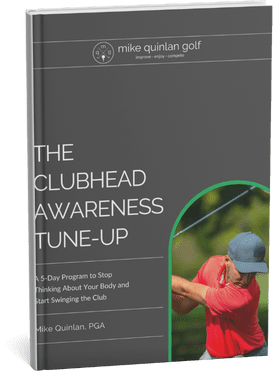
Download the FREE 5-Day Clubhead Awareness Tune-Up and learn the simple approach that makes golf easier, not harder.
More Examples: Internal vs. External Focus
Let’s look at common issues through both lenses:
Slicing the Ball
Internal Focus: “I’m coming over the top. I need to drop my right elbow in the slot and swing more from the inside while keeping the clubface square to path.”
(Thinking about body positions during the swing—impossible)
External Focus: “Swing the club head more from inside-right to outside-left through impact.”
(Simple club head path image—body adjusts automatically)
Inconsistent Contact
Internal Focus: “My weight shift is off. I’m hanging back. I need to push off my right foot earlier and get my pressure forward by impact.”
(Mechanical body monitoring mid-swing)
External Focus: “Release the club head aggressively toward the target.”
(Directional cue for club head—weight shift happens naturally)
Tension in the Swing
Internal Focus: “I’m gripping too tight. I need to maintain a pressure of 4 out of 10 and make sure my forearms stay relaxed through transition.”
(Impossible to monitor pressure levels mid-swing)
External Focus: “Feel the weight of the club head throughout the motion.”
(Sensory cue focused on club—releases tension automatically)
See the difference?
Internal focus tries to control the body’s HOW.
External focus defines the club head’s WHAT.
Your body is phenomenally good at figuring out the how—if you let it.
Why External Focus Works: The Science
This isn’t just philosophy. Motor learning research consistently shows:
External focus (club head, target, ball) produces:
- More consistent results
- Better retention
- Faster learning
- More automatic, fluid motion
Internal focus (body parts, positions) produces:
- Inconsistent results
- Interference with natural coordination
- Slower learning
- Mechanical, choppy motion
Why?
Because your nervous system is designed to accomplish external tasks, not manage internal positions. When you tell your body “swing the club head on this path,” it figures out how. When you tell it “rotate your hips exactly 47 degrees while maintaining left arm extension,” you override its natural problem-solving ability.
This is why The Approach emphasizes external focus: it’s how human beings are designed to learn athletic movements.
Ernest Jones understood this intuitively. De la Torre refined it into a teaching method. Modern science confirms it.

Feel Is the Language of Performance
Here’s what I want you to remember:
Mechanics are the language of The Analyst (range work).
Motion is the language of The Athlete (course play).
On the range, study cause and effect. Understand why the club head is doing what it’s doing. Work on changes.
On the course, swing the club head. Trust rhythm. See the target.
The moment you try to merge the two—the moment you start thinking about body mechanics during execution—you’re screwed.
You cannot practice and perform at the same time.
Practice builds the motion. Performance trusts it.
How to Make This Real
If you want to actually implement this, here’s your action plan:
1. Build Your Club Head Trigger Library (On the Range)
Experiment with different external cues focused on the club head and find 2-3 that work for YOU:
- “Sweep the club head low back and through”
- “Accelerate the club head through the ball”
- “Feel the club head release toward the target”
- “Swing the club head on an inside-out path”
Test them. See which ones produce good ball flight with the least mechanical thought.
Key rule: Every trigger must be about the CLUB HEAD, not your body.
2. Practice the Transition (Still on the Range)
Hit balls using ONLY your club head triggers. No body-focused thoughts allowed. If you catch yourself thinking about positions or body parts, stop and reset.
This is harder than it sounds. Your Analyst will fight you. Tell it to shut up.
3. Commit on the Course (Non-Negotiable)
Once you’re playing, the rule is absolute: Athlete mode only. Club head focus only.
Pick your trigger during your pre-shot routine—something simple about what you want the club head to do—then trust it completely. No adjustments. No monitoring. No mechanical thoughts.
If you hit a bad shot, resist the urge to analyze body positions immediately. Ask: “What did the club head do?” Make a mental note for the range later, but don’t contaminate the next shot with internal focus.
The Bottom Line
You already know how to swing a golf club.
You’ve done it hundreds, maybe thousands of times. The motion is stored in your body. The coordination is built.
The only thing stopping you from accessing it is misdirected focus.
Stop thinking about body positions during the swing. Stop trying to micromanage mechanics in a motion that happens too fast for conscious thought. Stop focusing internally when you need to focus externally.
Focus on the club head. Trust your body to support it.
During the swing, your only job is to swing the club head toward your target with good rhythm.
That’s it. That’s the entire game.
That’s the Mike Quinlan Approach.
And it’s built on the timeless wisdom of Ernest Jones and Manuel de la Torre: The swing is the motion. The club head is paramount. Everything else takes care of itself.
Take Your Game to the Next Level
Ready to build a swing based on motion and external focus—one that actually works on the course? Let’s work together to develop the club head awareness that creates consistent, athletic performance.
Book your first lesson and learn how the Mike Quinlan Approach uses external focus to create the automatic, trustworthy swing you’ve been searching for.
Learn more about The Approach and discover why focusing on the club head beats thinking about body positions every single time.
The Mike Quinlan Approach teaches golfers to focus externally on the club head and the target—not internally on body positions—because that’s how your nervous system is designed to produce athletic motion. Master the club head, and your body takes care of itself.